

6 Free & Open-Source Log Management Tools in 2026
Log management tools centralize, store, and analyze logs from applications, servers, and cloud environments. Open-source options provide enterprise-grade features — collecting, indexing, and querying logs across distributed systems — without the per-GB costs of Splunk or Datadog.
Quick Comparison
| Tool | License | Best For | Storage | Query Language |
|---|---|---|---|---|
| Uptrace | AGPL v3 / Commercial | Unified observability | ClickHouse | SQL-like |
| Loki | AGPL v3 | Cost-efficient storage | Object storage | LogQL |
| ELK Stack | Elastic License 2.0 | Advanced full-text search | Elasticsearch | Lucene/KQL |
| Vector | MPL 2.0 | Log routing & pipelines | Multiple | VRL |
| Graylog | SSPL | Security & compliance | MongoDB/OpenSearch | Lucene |
| Fluent Bit | Apache 2.0 | Lightweight collection | Multiple | — |
6 Free & Open-Source Log Management Tools
Uptrace
License: AGPL v3 (Open Source) / Commercial
GitHub: https://github.com/uptrace/uptrace
Uptrace combines log management with distributed tracing and metrics in a unified observability platform, making it ideal for microservices troubleshooting. The open-source edition is free under AGPL v3, while advanced enterprise features are available in the commercial version.
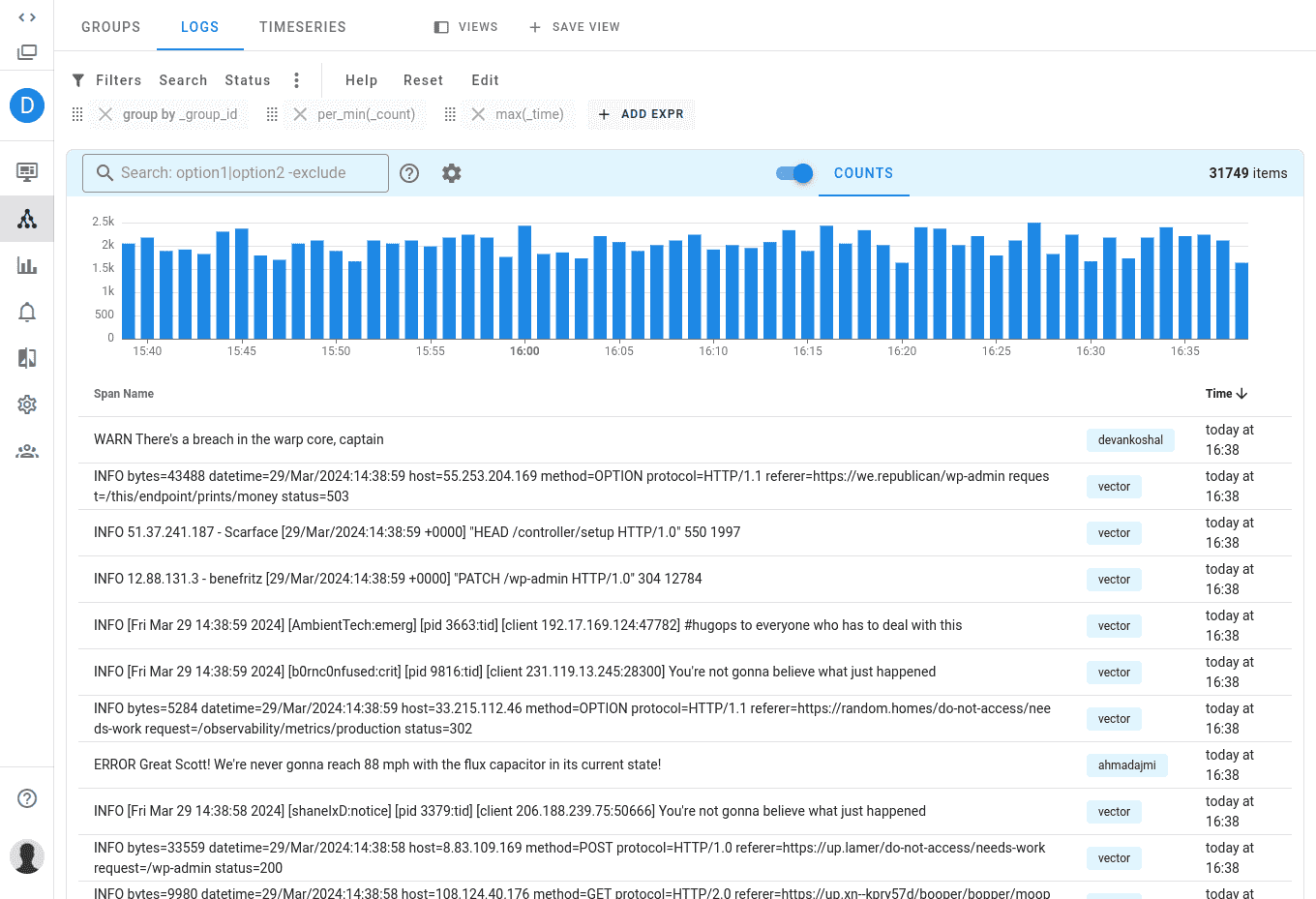
Key Log Management Features:
- Unified log storage for Kubernetes, Docker, and cloud-native applications.
- Trace-to-log linking to correlate error logs with OpenTelemetry traces.
- SQL-like querying with
WHERE,GROUP BY, andORDER BYclauses. - Grafana integration for real-time log visualization.
Why It Stands Out: Brings together log management and distributed tracing in one system.
Grafana Loki
License: GNU AGPL v3
GitHub: https://github.com/grafana/loki
Grafana Loki is an open-source log management tool optimized for cost-efficient storage and high-volume ingestion. Unlike traditional systems, Loki indexes metadata instead of full text, which can reduce storage costs by up to 10x.
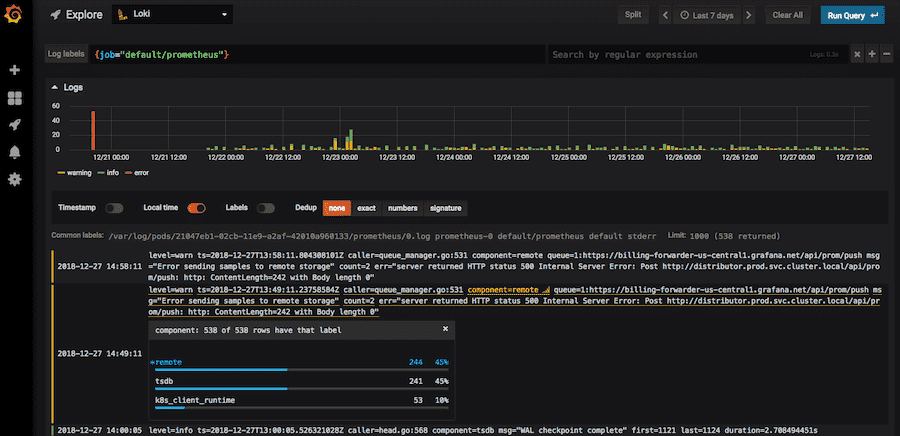
Key Log Management Features:
- Metadata-first indexing for reduced storage costs.
- Kubernetes-native with automatic labeling of pod and container logs.
- Live tail to stream logs in real time via CLI or GUI.
- Prometheus-compatible alerting based on log patterns.
ELK Stack
License: Elastic License 2.0
GitHub: https://github.com/elastic
ELK Stack is a widely adopted log management platform with advanced full-text search and visualization capabilities. The core components (Elasticsearch, Logstash, Kibana) are free under Elastic License 2.0, though the license restricts some commercial use cases.
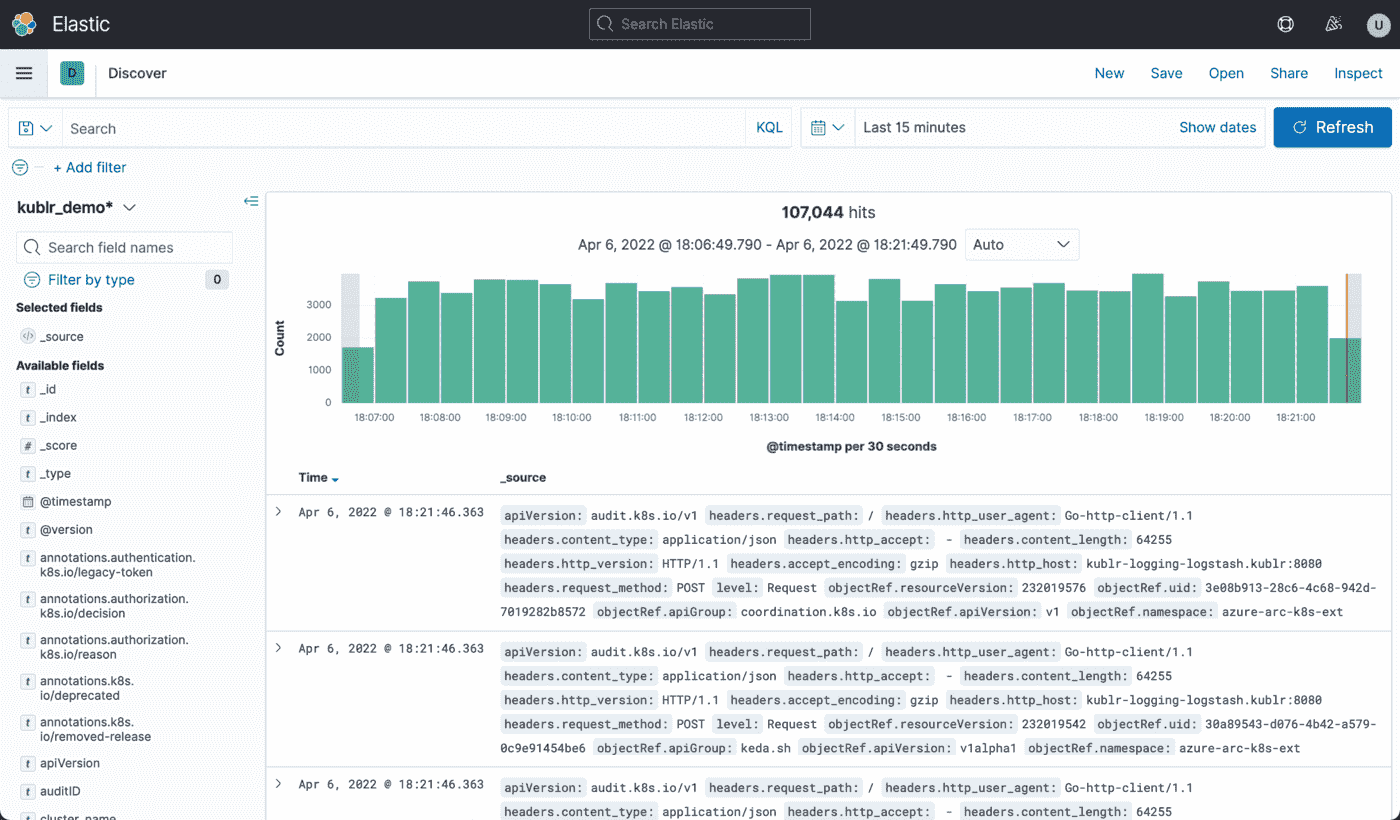
Key Log Management Features:
- Full-text search across massive datasets.
- Real-time log ingestion and analysis.
- Kibana dashboards for visualizing trends and anomalies.
- Beats agents for lightweight log forwarding.
- Machine learning for anomaly detection.
Vector
License: Mozilla Public License 2.0
GitHub: https://github.com/vectordotdev/vector
Vector is a high-performance log management pipeline designed to process, transform, and route logs across hybrid infrastructures. It is fully open-source and free to use.
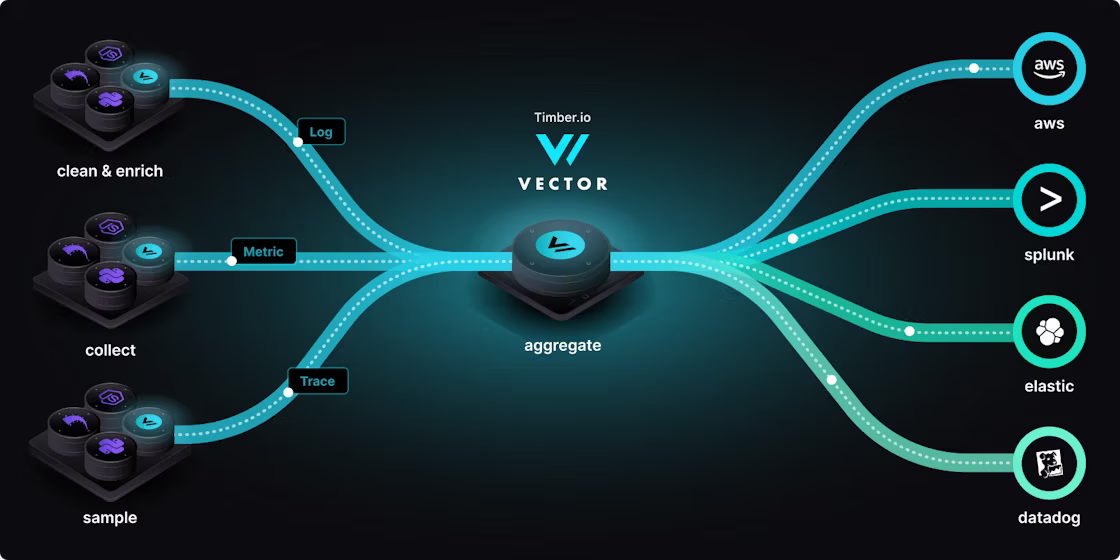
Key Log Management Features:
- 100+ integrations including AWS CloudWatch, Kafka, and Syslog.
- In-stream enrichment for adding fields like user ID or geoIP.
- Edge-optimized to handle logs on IoT devices before transmission.
- Declarative YAML pipelines for observability-as-code.
Graylog
License: Server Side Public License (SSPL)
GitHub: https://github.com/Graylog2/graylog2-server
Graylog is a security-focused log management system used for compliance auditing and threat detection. Its free open-source edition is available under SSPL, with advanced enterprise features offered separately.
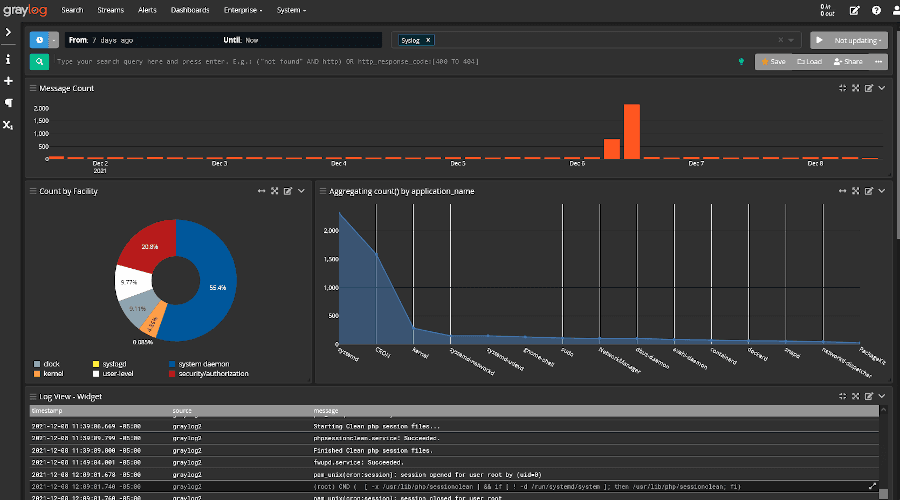
Key Log Management Features:
- GDPR-ready with anonymization and retention policies.
- Threat detection rules for common attack patterns.
- Forensic search with bookmarking and annotation.
- LDAP/AD sync for enterprise user management.
Fluent Bit
License: Apache License 2.0
GitHub: https://github.com/fluent/fluent-bit
Fluent Bit is a lightweight log management agent built for containers, IoT, and edge environments. It is widely adopted in Kubernetes ecosystems and trusted by major cloud providers.
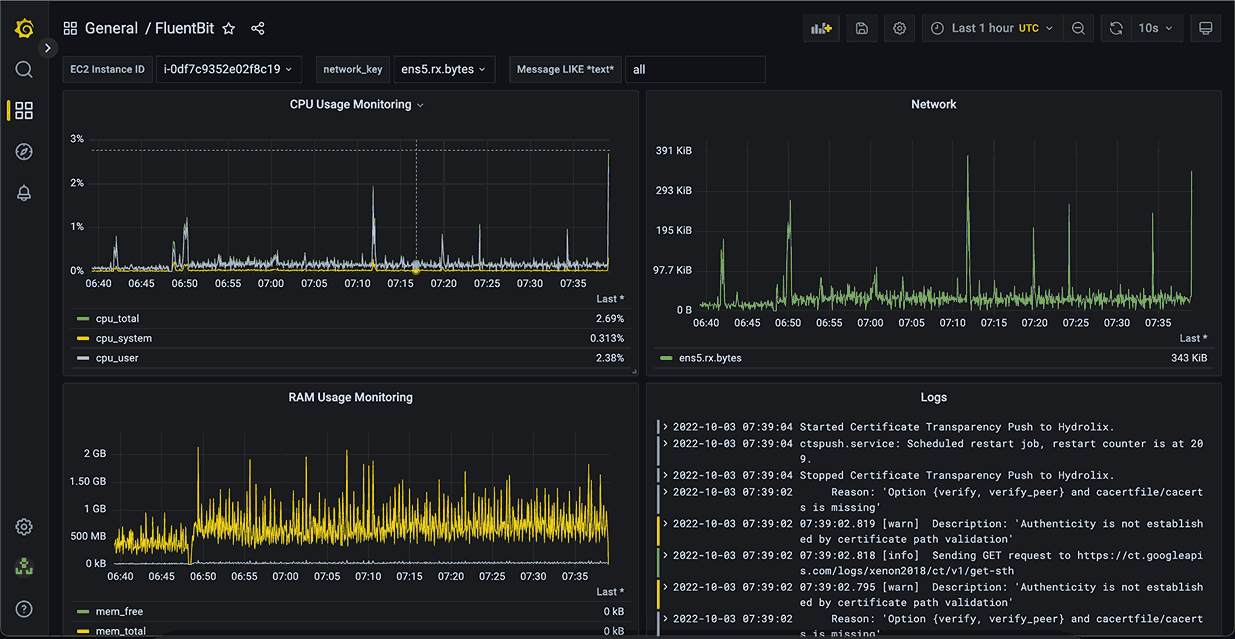
Key Log Management Features:
- Tiny 4MB binary optimized for sidecars and ARM devices.
- Multiline log parsing to handle stack traces.
- Dynamic tagging for routing logs by Kubernetes labels.
- CNCF graduated project backed by AWS, Microsoft, and Google Cloud.
How to Choose the Right Tool?
- Microservices troubleshooting: Uptrace — trace-to-log correlation across services
- Advanced log search: ELK Stack — full-text search with Lucene/KQL
- Security & compliance: Graylog — built-in threat detection and GDPR features
- Cost optimization: Loki — metadata-only indexing cuts storage costs up to 10x
- Complex routing: Vector — transform and route logs across hybrid infrastructure
- Edge & containers: Fluent Bit — 4 MB binary, minimal resource footprint
For teams that also need application performance monitoring, Uptrace and ELK Stack offer the broadest coverage since they handle both logs and performance data in a single platform.
FAQ
What is the best open-source log management tool in 2026?
It depends on your use case: Loki for cost efficiency, Graylog for security, and Uptrace for combined logs and tracing.
What’s the difference between log management and log analysis?
Log management covers collecting, storing, and organizing logs. Log analysis focuses on searching, parsing, and interpreting them to find patterns and anomalies.
Which free log management software is an alternative to Splunk?
ELK Stack, Loki, and Graylog are the most popular free alternatives to Splunk, each with different strengths in search, scalability, and security.
Which tool combines logs with application tracing?
Uptrace correlates logs with distributed traces and metrics in a single platform.
What’s the most cost-effective option for high log volumes?
Loki indexes only metadata instead of full text, which can reduce storage costs by up to 10x compared to full-text indexing.
Which tool works best with existing Grafana setups?
Loki integrates natively with Grafana dashboards and uses Prometheus-style labeling.
You may also be interested in: