

OpenTelemetry Golang gRPC monitoring [otelgrpc]
OpenTelemetry gRPC instrumentation (otelgrpc) provides automatic tracing and metrics collection for gRPC clients and servers in Go, capturing RPC method details, status codes, and timing information without manual instrumentation.
Quick Setup
| Step | Action | Code/Command |
|---|---|---|
| 1. Install | Install otelgrpc package | go get go.opentelemetry.io/contrib/instrumentation/google.golang.org/grpc/otelgrpc |
| 2. Client | Add StatsHandler to client | grpc.WithStatsHandler(otelgrpc.NewClientHandler()) |
| 3. Server | Add StatsHandler to server | grpc.StatsHandler(otelgrpc.NewServerHandler()) |
| 4. Verify | Check your backend for traces | Traces collected automatically |
What's collected:
- Traces: Full RPC call traces with method, service, and status code
- Metrics: Request duration, message size, call counts
- Context propagation: Automatic trace context across services via gRPC metadata
Complete Working Example
Below is a full example showing a gRPC server and client instrumented with otelgrpc. It assumes you have a protobuf service defined like this:
// greeter.proto
syntax = "proto3";
package greeter;
option go_package = "example/greeter";

service Greeter {
  rpc SayHello (HelloRequest) returns (HelloReply);
}

message HelloRequest {
  string name = 1;
}

message HelloReply {
  string message = 1;
}
With generated Go code in greeter/, the instrumented server and client look like this:
package main

import (
    "context"
    "fmt"
    "log"
    "net"
    "time"

    "google.golang.org/grpc"
    "google.golang.org/grpc/credentials/insecure"
    "go.opentelemetry.io/contrib/instrumentation/google.golang.org/grpc/otelgrpc"
    "go.opentelemetry.io/otel"
    "go.opentelemetry.io/otel/exporters/otlp/otlptrace/otlptracegrpc"
    "go.opentelemetry.io/otel/sdk/resource"
    sdktrace "go.opentelemetry.io/otel/sdk/trace"
    semconv "go.opentelemetry.io/otel/semconv/v1.26.0"

    pb "example/greeter"
)

// Server implementation
type greeterServer struct {
    pb.UnimplementedGreeterServer
}

func (s *greeterServer) SayHello(ctx context.Context, req *pb.HelloRequest) (*pb.HelloReply, error) {
    return &pb.HelloReply{Message: "Hello " + req.GetName()}, nil
}

func main() {
    ctx := context.Background()

    // Initialize the OTLP trace exporter.
    exporter, err := otlptracegrpc.New(ctx)
    if err != nil {
        log.Fatalf("failed to create exporter: %v", err)
    }

    // Create a TracerProvider with the exporter.
    tp := sdktrace.NewTracerProvider(
        sdktrace.WithBatcher(exporter),
        sdktrace.WithResource(resource.NewWithAttributes(
            semconv.SchemaURL,
            semconv.ServiceName("grpc-example"),
        )),
    )
    defer tp.Shutdown(ctx)
    otel.SetTracerProvider(tp)

    // Start the instrumented gRPC server in a goroutine.
    go func() {
        lis, err := net.Listen("tcp", ":9090")
        if err != nil {
            log.Fatalf("failed to listen: %v", err)
        }

        server := grpc.NewServer(
            grpc.StatsHandler(otelgrpc.NewServerHandler()),
        )
        pb.RegisterGreeterServer(server, &greeterServer{})

        log.Println("gRPC server listening on :9090")
        if err := server.Serve(lis); err != nil {
            log.Fatalf("failed to serve: %v", err)
        }
    }()

    // Give the server a moment to start.
    time.Sleep(100 * time.Millisecond)

    // Create an instrumented gRPC client.
    conn, err := grpc.NewClient("localhost:9090",
        grpc.WithTransportCredentials(insecure.NewCredentials()),
        grpc.WithStatsHandler(otelgrpc.NewClientHandler()),
    )
    if err != nil {
        log.Fatalf("failed to connect: %v", err)
    }
    defer conn.Close()

    client := pb.NewGreeterClient(conn)

    resp, err := client.SayHello(context.Background(), &pb.HelloRequest{Name: "World"})
    if err != nil {
        log.Fatalf("SayHello failed: %v", err)
    }
    fmt.Println(resp.GetMessage())
}
This produces connected client and server spans for every SayHello call, with RPC method, service name, and status code attributes attached automatically.
What is gRPC?
gRPC is a high-performance, cross-platform Remote Procedure Call (RPC) framework originally developed by Google. It uses HTTP/2 for transport and Protocol Buffers for serialization, making it well-suited for microservice communication where low latency and strong typing are important.
gRPC Instrumentation
To install otelgrpc instrumentation:
go get go.opentelemetry.io/contrib/instrumentation/google.golang.org/grpc/otelgrpc
The otelgrpc package uses the gRPC StatsHandler interface, which provides more accurate telemetry than the older interceptor approach. StatsHandler has access to lower-level transport events and produces better timing data.
Usage
Instrumenting gRPC Client
import (
    "crypto/tls"
    "google.golang.org/grpc"
    "google.golang.org/grpc/credentials"
    "google.golang.org/grpc/credentials/insecure"
    "go.opentelemetry.io/contrib/instrumentation/google.golang.org/grpc/otelgrpc"
)

// For insecure connections (development)
conn, err := grpc.NewClient(target,
    grpc.WithTransportCredentials(insecure.NewCredentials()),
    grpc.WithStatsHandler(otelgrpc.NewClientHandler()),
)

// For TLS connections (production)
conn, err := grpc.NewClient(target,
    grpc.WithTransportCredentials(credentials.NewTLS(&tls.Config{})),
    grpc.WithStatsHandler(otelgrpc.NewClientHandler()),
)
Note: grpc.WithInsecure() is deprecated. Use grpc.WithTransportCredentials(insecure.NewCredentials()) for insecure connections.
Instrumenting gRPC Server
import (
    "google.golang.org/grpc"
    "go.opentelemetry.io/contrib/instrumentation/google.golang.org/grpc/otelgrpc"
)

server := grpc.NewServer(
    grpc.StatsHandler(otelgrpc.NewServerHandler()),
)
Filtering Methods
Use WithFilter to exclude specific RPC methods from instrumentation. This is useful for health checks and other high-frequency, low-value calls that would otherwise generate noise:
import (
    "google.golang.org/grpc"
    "google.golang.org/grpc/stats"
    "go.opentelemetry.io/contrib/instrumentation/google.golang.org/grpc/otelgrpc"
)

serverHandler := otelgrpc.NewServerHandler(
    otelgrpc.WithFilter(func(info *stats.RPCTagInfo) bool {
        // Return false to exclude a method from tracing.
        return info.FullMethodName != "/grpc.health.v1.Health/Check"
    }),
)

server := grpc.NewServer(
    grpc.StatsHandler(serverHandler),
)
You can combine multiple filters. For example, exclude both health checks and reflection:
serverHandler := otelgrpc.NewServerHandler(
    otelgrpc.WithFilter(func(info *stats.RPCTagInfo) bool {
        switch info.FullMethodName {
        case "/grpc.health.v1.Health/Check",
            "/grpc.health.v1.Health/Watch",
            "/grpc.reflection.v1alpha.ServerReflection/ServerReflectionInfo":
            return false
        }
        return true
    }),
)
Streaming RPCs
The otelgrpc StatsHandler instruments streaming RPCs automatically. Each stream gets its own span, and individual message send/receive events can be recorded within that span.
For server-streaming, client-streaming, or bidirectional-streaming RPCs, the instrumentation creates a span that covers the entire stream lifetime, from open to close:
server := grpc.NewServer(
    grpc.StatsHandler(otelgrpc.NewServerHandler(
        otelgrpc.WithMessageEvents(otelgrpc.ReceivedEvents, otelgrpc.SentEvents),
    )),
)
With message events enabled, each message sent or received on the stream is recorded as a span event with the message sequence number and size. This gives you visibility into streaming throughput and message patterns.
Recording Message Events
By default, otelgrpc does not record individual message send/receive events on spans. You can enable them with WithMessageEvents:
// Record message send/receive events on client spans
clientHandler := otelgrpc.NewClientHandler(
    otelgrpc.WithMessageEvents(otelgrpc.ReceivedEvents, otelgrpc.SentEvents),
)

// Record only received events on server spans
serverHandler := otelgrpc.NewServerHandler(
    otelgrpc.WithMessageEvents(otelgrpc.ReceivedEvents),
)
Each message event includes message.id (sequence number) and message.uncompressed_size attributes.
Performance note: Message events add overhead for high-throughput services because each message creates an additional span event. For services handling thousands of RPCs per second, consider enabling them selectively or only in staging environments.
Configuration Options
You can configure the otelgrpc handlers with various options:
import (
    "go.opentelemetry.io/contrib/instrumentation/google.golang.org/grpc/otelgrpc"
)

clientHandler := otelgrpc.NewClientHandler(
    otelgrpc.WithTracerProvider(tracerProvider),
    otelgrpc.WithMeterProvider(meterProvider),
    otelgrpc.WithMessageEvents(otelgrpc.ReceivedEvents),
)

conn, err := grpc.NewClient(target,
    grpc.WithTransportCredentials(insecure.NewCredentials()),
    grpc.WithStatsHandler(clientHandler),
)
Available options:
| Option | Description |
|---|---|
WithTracerProvider() | Use a custom TracerProvider instead of the global one |
WithMeterProvider() | Use a custom MeterProvider instead of the global one |
WithMessageEvents() | Record sent/received message events on spans |
WithMetricAttributes() | Add custom attributes to collected metrics |
WithFilter() | Exclude specific methods from instrumentation |
WithPropagators() | Specify custom propagators for context propagation |
Metadata and Baggage
gRPC metadata and OpenTelemetry baggage serve different purposes but both propagate key-value pairs across service boundaries.
gRPC metadata is transport-level. Use it for request-scoped values that your gRPC handlers need to access directly:
import "google.golang.org/grpc/metadata"

// Client side: attach metadata to outgoing call
md := metadata.Pairs(
    "request-id", "abc-123",
    "user-id", "user-456",
)
ctx := metadata.NewOutgoingContext(context.Background(), md)

resp, err := client.SayHello(ctx, &pb.HelloRequest{Name: "World"})
import "google.golang.org/grpc/metadata"

// Server side: extract metadata from incoming request
if md, ok := metadata.FromIncomingContext(ctx); ok {
    if vals := md.Get("request-id"); len(vals) > 0 {
        fmt.Println("request-id:", vals[0])
    }
}
OpenTelemetry baggage is propagated through the trace context and available to any instrumented service in the call chain:
import "go.opentelemetry.io/otel/baggage"

// Read baggage from context (propagated automatically by otelgrpc)
bag := baggage.FromContext(ctx)
val := bag.Member("tenant.id").Value()
Use gRPC metadata when the values are only needed by the immediate caller/callee. Use OpenTelemetry baggage when values need to propagate through an entire distributed trace.
Error Handling
The otelgrpc instrumentation automatically maps gRPC status codes to OpenTelemetry span statuses:
codes.OKsets span status to Unset (success)- Any non-OK code (e.g.,
NotFound,Internal,Unavailable) sets span status to Error
The gRPC status code is always recorded as the rpc.grpc.status_code attribute, so you can filter and group spans by status in your backend.
If you need to record additional error details within a handler, use the span API directly:
import (
    "google.golang.org/grpc/codes"
    "google.golang.org/grpc/status"
    "go.opentelemetry.io/otel/trace"
    otelcodes "go.opentelemetry.io/otel/codes"
)

func (s *myServer) GetUser(ctx context.Context, req *pb.GetUserRequest) (*pb.User, error) {
    span := trace.SpanFromContext(ctx)

    user, err := s.db.FindUser(ctx, req.GetId())
    if err != nil {
        // Record the error on the span for extra detail.
        span.RecordError(err)
        span.SetStatus(otelcodes.Error, "database lookup failed")
        return nil, status.Errorf(codes.Internal, "failed to fetch user: %v", err)
    }
    if user == nil {
        return nil, status.Error(codes.NotFound, "user not found")
    }

    return user, nil
}
Collected Metrics
The otelgrpc instrumentation automatically collects the following metrics:
Metrics Summary
| Metric | Type | Description |
|---|---|---|
rpc.client.duration | Histogram | Duration of outbound RPC calls |
rpc.client.request.size | Histogram | Size of outbound request messages |
rpc.client.response.size | Histogram | Size of outbound response messages |
rpc.client.requests_per_rpc | Histogram | Messages sent per RPC (streaming) |
rpc.client.responses_per_rpc | Histogram | Messages received per RPC (streaming) |
rpc.server.duration | Histogram | Duration of inbound RPC calls |
rpc.server.request.size | Histogram | Size of inbound request messages |
rpc.server.response.size | Histogram | Size of inbound response messages |
rpc.server.requests_per_rpc | Histogram | Messages received per RPC (streaming) |
rpc.server.responses_per_rpc | Histogram | Messages sent per RPC (streaming) |
Common Attributes
All metrics include these attributes from the OpenTelemetry RPC semantic conventions:
| Attribute | Description | Example |
|---|---|---|
rpc.system | RPC system identifier | grpc |
rpc.service | Full name of the RPC service | greeter.Greeter |
rpc.method | Name of the RPC method | SayHello |
rpc.grpc.status_code | Numeric gRPC status code | 0 (OK) |
Troubleshooting
Deprecated grpc.WithInsecure() Error
Problem: Code fails with "grpc.WithInsecure is deprecated" or similar error.
Solution: Replace with grpc.WithTransportCredentials(insecure.NewCredentials()):
// Old (deprecated)
conn, err := grpc.Dial(target, grpc.WithInsecure())

// New (correct)
import "google.golang.org/grpc/credentials/insecure"

conn, err := grpc.NewClient(target,
    grpc.WithTransportCredentials(insecure.NewCredentials()),
)
Using Deprecated Interceptors
Problem: Old code uses UnaryClientInterceptor() or UnaryServerInterceptor().
Solution: Migrate to StatsHandler-based instrumentation:
// Old (deprecated interceptors)
conn, err := grpc.Dial(target,
    grpc.WithUnaryInterceptor(otelgrpc.UnaryClientInterceptor()),
    grpc.WithStreamInterceptor(otelgrpc.StreamClientInterceptor()),
)

// New (StatsHandler)
conn, err := grpc.NewClient(target,
    grpc.WithStatsHandler(otelgrpc.NewClientHandler()),
)
StatsHandler provides better performance and more accurate metrics compared to interceptors.
Missing Trace Context
Problem: Trace context not propagating between client and server.
Solution: Ensure both client and server use otelgrpc instrumentation. The instrumentation uses gRPC metadata to propagate trace context automatically, so no manual context injection is needed:
// Client side - automatically injects trace context
conn, err := grpc.NewClient(target,
    grpc.WithStatsHandler(otelgrpc.NewClientHandler()),
)

// Server side - automatically extracts trace context
server := grpc.NewServer(
    grpc.StatsHandler(otelgrpc.NewServerHandler()),
)
If context still does not propagate, verify that you have a global TextMapPropagator set (otelgrpc uses it to inject/extract headers):
import "go.opentelemetry.io/otel"
import "go.opentelemetry.io/otel/propagation"

otel.SetTextMapPropagator(propagation.NewCompositeTextMapPropagator(
    propagation.TraceContext{},
    propagation.Baggage{},
))
No Metrics Collected
Problem: Traces appear but metrics are missing.
Solution: Make sure you have a MeterProvider configured. Without one, otelgrpc uses a no-op provider that discards all metrics:
import (
    "go.opentelemetry.io/otel"
    sdkmetric "go.opentelemetry.io/otel/sdk/metric"
)

// Set up a MeterProvider with your exporter
meterProvider := sdkmetric.NewMeterProvider(
    sdkmetric.WithReader(sdkmetric.NewPeriodicReader(exporter)),
)
otel.SetMeterProvider(meterProvider)
defer meterProvider.Shutdown(context.Background())
High Cardinality Warning
Problem: Metric cardinality is too high, causing memory or cost issues.
Solution: Avoid adding high-cardinality attributes (like user IDs or request IDs) to metrics via WithMetricAttributes. Stick to low-cardinality values such as service name, method, and status code. Use span attributes for high-cardinality data instead.
What is Uptrace?
Uptrace is an OpenTelemetry APM that supports distributed tracing, metrics, and logs. You can use it to monitor applications and troubleshoot issues.
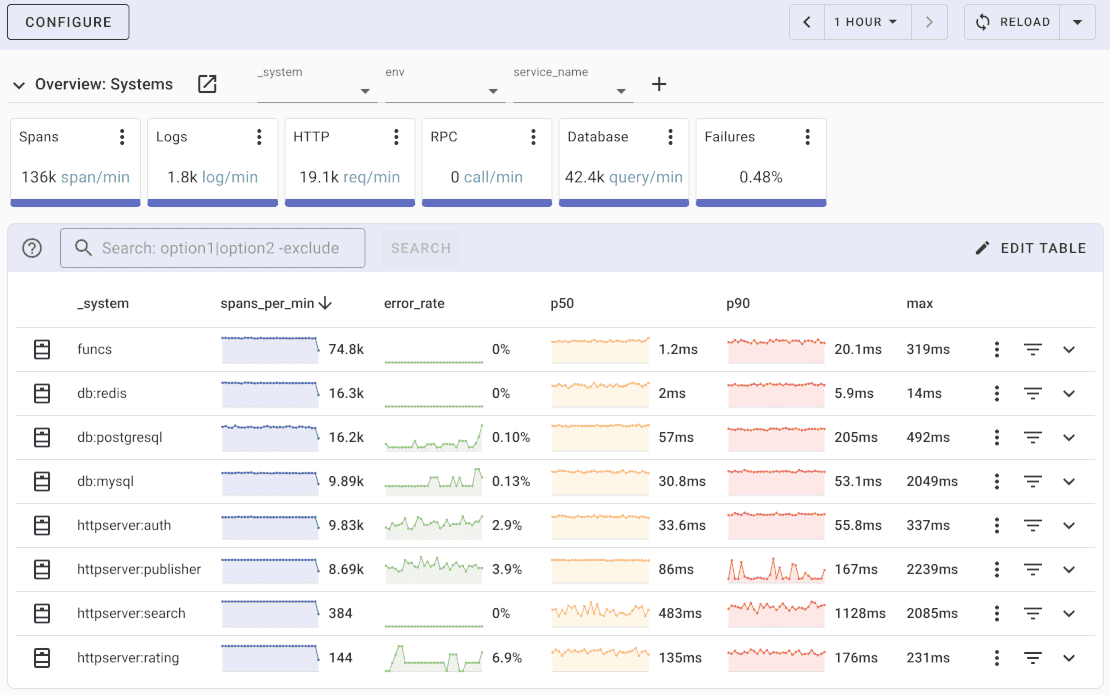
Uptrace can process billions of spans and metrics on a single server and allows you to monitor your applications at 10x lower cost.
In just a few minutes, you can try Uptrace by visiting the cloud demo (no login required) or running it locally with Docker. The source code is available on GitHub.
What's next?
With otelgrpc in place, your gRPC services have automatic tracing and metrics. Here are some next steps:
- Add database tracing with OpenTelemetry GORM or OpenTelemetry database/sql
- Instrument HTTP services with OpenTelemetry Gin or OpenTelemetry Echo
- Create custom spans using the OpenTelemetry Go Tracing API
- Collect custom metrics with the OpenTelemetry Go Metrics API
- Set up the OpenTelemetry Collector for production deployments
- Learn about OpenTelemetry environment variables for configuration management