

OpenTelemetry Tomcat: Instrumentation and Monitoring Guide
OpenTelemetry provides automatic instrumentation for Apache Tomcat applications, enabling distributed tracing, JVM metrics collection, and servlet monitoring without code changes. Using the OpenTelemetry Java Agent, you can gain full observability into your Tomcat-hosted web applications, including request latencies, database queries, and downstream service calls.
Quick Reference
| Component | Details |
|---|---|
| Instrumentation method | OpenTelemetry Java Agent (automatic) |
| Supported signals | Traces, Metrics, Logs |
| Code changes required | None (agent-based) |
| Configuration | Environment variables in setenv.sh / setenv.bat |
| Libraries instrumented | Servlets, JSP, JDBC, HTTP clients, JMS, and 150+ more |
What is OpenTelemetry?
OpenTelemetry is an open-source observability framework that standardizes the collection of telemetry data from applications. It provides three pillars of observability:
- Distributed Traces: Track requests across services and components
- Metrics: Collect JVM, servlet, and application-level measurements
- Logs: Capture structured application logs with trace correlation
OpenTelemetry is vendor-neutral, meaning you can export data to any compatible OpenTelemetry backend such as Uptrace, Jaeger, or Grafana. Configuration is managed through environment variables.
Prerequisites
- Apache Tomcat 7.0+ (Tomcat 9 and 10 recommended)
- Java 8+ (Java 11+ recommended for full metrics support)
- Network access to your OTLP-compatible backend
OpenTelemetry Java Agent
The OpenTelemetry Java Agent automatically instruments Tomcat applications at the bytecode level, capturing traces for servlets, JDBC queries, HTTP clients, and 150+ libraries without code changes.
Download the latest agent JAR:
wget https://github.com/open-telemetry/opentelemetry-java-instrumentation/releases/latest/download/opentelemetry-javaagent.jar
Place the JAR in a directory accessible by Tomcat, such as /opt/opentelemetry/ or Tomcat's lib directory.
For detailed agent configuration options and troubleshooting, see the Java zero-code instrumentation guide.
Configuring Tomcat with OpenTelemetry
Linux / macOS
Create a setenv.sh file in Tomcat's bin directory:
#!/bin/bash

# Attach the OpenTelemetry Java Agent
export CATALINA_OPTS="$CATALINA_OPTS -javaagent:/opt/opentelemetry/opentelemetry-javaagent.jar"

# Service identification
export OTEL_RESOURCE_ATTRIBUTES=service.name=tomcat-app,service.version=1.0.0

# Enable all signal types
export OTEL_TRACES_EXPORTER=otlp
export OTEL_METRICS_EXPORTER=otlp
export OTEL_LOGS_EXPORTER=otlp

# OTLP exporter configuration
export OTEL_EXPORTER_OTLP_COMPRESSION=gzip
export OTEL_EXPORTER_OTLP_ENDPOINT=https://api.uptrace.dev:4317
export OTEL_EXPORTER_OTLP_HEADERS="uptrace-dsn=<FIXME>"

# Recommended metrics settings
export OTEL_EXPORTER_OTLP_METRICS_TEMPORALITY_PREFERENCE=DELTA
export OTEL_EXPORTER_OTLP_METRICS_DEFAULT_HISTOGRAM_AGGREGATION=BASE2_EXPONENTIAL_BUCKET_HISTOGRAM
Make the script executable and restart Tomcat:
chmod +x bin/setenv.sh
./bin/shutdown.sh && ./bin/startup.sh
Windows
Create a setenv.bat file in Tomcat's bin directory:
set "CATALINA_OPTS=%CATALINA_OPTS% -javaagent:C:\opentelemetry\opentelemetry-javaagent.jar"

set OTEL_RESOURCE_ATTRIBUTES=service.name=tomcat-app,service.version=1.0.0
set OTEL_TRACES_EXPORTER=otlp
set OTEL_METRICS_EXPORTER=otlp
set OTEL_LOGS_EXPORTER=otlp
set OTEL_EXPORTER_OTLP_COMPRESSION=gzip
set OTEL_EXPORTER_OTLP_ENDPOINT=https://api.uptrace.dev:4317
set OTEL_EXPORTER_OTLP_HEADERS=uptrace-dsn=<FIXME>
set OTEL_EXPORTER_OTLP_METRICS_TEMPORALITY_PREFERENCE=DELTA
set OTEL_EXPORTER_OTLP_METRICS_DEFAULT_HISTOGRAM_AGGREGATION=BASE2_EXPONENTIAL_BUCKET_HISTOGRAM
Docker
For containerized Tomcat deployments, pass the agent as a JVM argument in your Dockerfile:
FROM tomcat:10-jdk17

# Download OpenTelemetry Java Agent
ADD https://github.com/open-telemetry/opentelemetry-java-instrumentation/releases/latest/download/opentelemetry-javaagent.jar /opt/opentelemetry/opentelemetry-javaagent.jar

# Set environment variables
ENV CATALINA_OPTS="-javaagent:/opt/opentelemetry/opentelemetry-javaagent.jar"
ENV OTEL_RESOURCE_ATTRIBUTES="service.name=tomcat-app,service.version=1.0.0"
ENV OTEL_TRACES_EXPORTER="otlp"
ENV OTEL_METRICS_EXPORTER="otlp"
ENV OTEL_LOGS_EXPORTER="otlp"
ENV OTEL_EXPORTER_OTLP_COMPRESSION="gzip"

# Deploy your application
COPY target/myapp.war /usr/local/tomcat/webapps/
Build and run:
docker build -t tomcat-otel .
docker run -p 8080:8080 \
  -e OTEL_EXPORTER_OTLP_ENDPOINT=https://api.uptrace.dev:4317 \
  -e OTEL_EXPORTER_OTLP_HEADERS="uptrace-dsn=<FIXME>" \
  tomcat-otel
For a complete Docker Compose setup with the OpenTelemetry Collector, see the Docker deployment guide.
Verifying the Installation
After restarting Tomcat, verify the agent is attached by checking the Tomcat logs:
tail -f logs/catalina.out | grep -i opentelemetry
You should see output similar to:
[otel.javaagent] opentelemetry-javaagent - version: 2.x.x
[otel.javaagent] Installed instrumentation: servlet-5.0 [io.opentelemetry.javaagent]
[otel.javaagent] Installed instrumentation: tomcat-10.0 [io.opentelemetry.javaagent]
You can also verify from a running process:
ps aux | grep javaagent
What Gets Instrumented Automatically
The Java Agent instruments these Tomcat components without code changes:
| Component | Captured Data |
|---|---|
| HTTP Servlets | Request method, URL, status code, latency |
| JSP Pages | Rendering time, template name |
| JDBC | Database queries, connection pool metrics |
| HTTP Clients | Outgoing requests (HttpURLConnection, Apache HttpClient) |
| JMS | Message queue operations |
| JMX Metrics | JVM memory, GC, thread counts, CPU usage |
Custom Instrumentation
For application-specific tracing beyond automatic instrumentation, add the OpenTelemetry API to your project.
Add the dependency to pom.xml:
<dependency>
    <groupId>io.opentelemetry</groupId>
    <artifactId>opentelemetry-api</artifactId>
    <version>1.44.1</version>
</dependency>
Create custom spans in your servlets:
import io.opentelemetry.api.GlobalOpenTelemetry;
import io.opentelemetry.api.trace.Span;
import io.opentelemetry.api.trace.Tracer;
import jakarta.servlet.http.*;

public class OrderServlet extends HttpServlet {
    private static final Tracer tracer =
        GlobalOpenTelemetry.getTracer("com.example.orders");

    @Override
    protected void doPost(HttpServletRequest req, HttpServletResponse resp) {
        Span span = tracer.spanBuilder("process-order").startSpan();
        try (var scope = span.makeCurrent()) {
            String orderId = req.getParameter("orderId");
            span.setAttribute("order.id", orderId);

            // Your business logic
            processOrder(orderId);

            span.setAttribute("order.status", "completed");
        } catch (Exception e) {
            span.recordException(e);
            span.setStatus(io.opentelemetry.api.trace.StatusCode.ERROR, e.getMessage());
            resp.setStatus(500);
        } finally {
            span.end();
        }
    }
}
For comprehensive Java instrumentation, see the OpenTelemetry Java guide.
Environment Variables Reference
Common environment variables for tuning the Java Agent with Tomcat:
| Variable | Description | Example Value |
|---|---|---|
OTEL_SERVICE_NAME | Service name | tomcat-app |
OTEL_EXPORTER_OTLP_ENDPOINT | OTLP collector endpoint | https://api.uptrace.dev:4317 |
OTEL_EXPORTER_OTLP_HEADERS | Authentication headers | uptrace-dsn=<FIXME> |
OTEL_TRACES_SAMPLER | Sampling strategy | parentbased_traceidratio |
OTEL_TRACES_SAMPLER_ARG | Sampling ratio (0.0 to 1.0) | 0.1 |
OTEL_INSTRUMENTATION_HTTP_CAPTURE_HEADERS_SERVER_REQUEST | Capture request headers | content-type,x-request-id |
OTEL_JAVAAGENT_DEBUG | Enable debug logging | true |
For the full list of environment variables, see the OpenTelemetry environment variables reference.
Troubleshooting
Agent not loading: Verify the -javaagent path is correct and the JAR file is readable by the Tomcat process user. Check catalina.out for errors.
No traces appearing: Confirm OTEL_EXPORTER_OTLP_ENDPOINT is reachable from the Tomcat server. Test connectivity:
curl -v https://api.uptrace.dev:4317
High memory usage: Reduce the export batch size and queue:
export OTEL_BSP_MAX_QUEUE_SIZE=512
export OTEL_BSP_MAX_EXPORT_BATCH_SIZE=128
Startup performance: The agent adds 100-300ms to startup. For faster startup in development, disable unused instrumentations:
export OTEL_INSTRUMENTATION_COMMON_DEFAULT_ENABLED=false
export OTEL_INSTRUMENTATION_SERVLET_ENABLED=true
export OTEL_INSTRUMENTATION_JDBC_ENABLED=true
Debug logging: Enable agent debug output to diagnose issues:
export OTEL_JAVAAGENT_DEBUG=true
What is Uptrace?
Uptrace is an OpenTelemetry APM that supports distributed tracing, metrics, and logs. You can use it to monitor applications and troubleshoot issues.
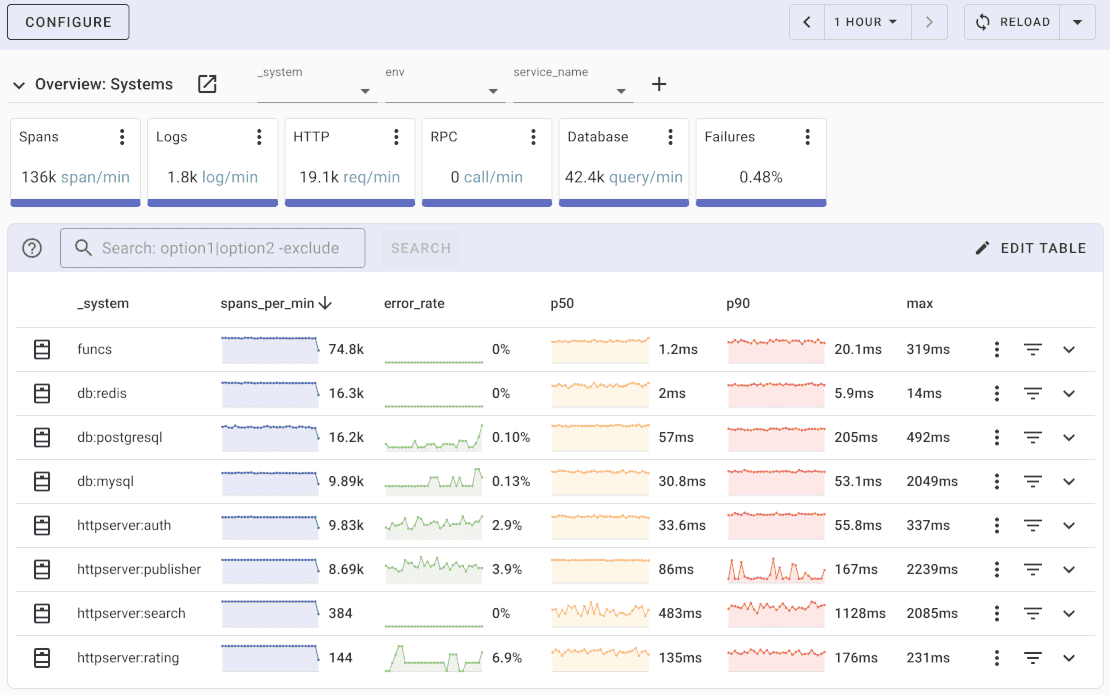
Uptrace comes with an intuitive query builder, rich dashboards, alerting rules with notifications, and integrations for most languages and frameworks.
Uptrace can process billions of spans and metrics on a single server and allows you to monitor your applications at 10x lower cost.
In just a few minutes, you can try Uptrace by visiting the cloud demo (no login required) or running it locally with Docker. The source code is available on GitHub.
What's next?
Your Tomcat server is now instrumented with OpenTelemetry for comprehensive monitoring. Next steps:
- Spring Boot instrumentation for Spring-based Tomcat applications
- Quarkus instrumentation for an alternative Java framework
- Docker deployment for containerized Tomcat applications
- OpenTelemetry Java guide for deeper instrumentation options