

Monitor K8s with OpenTelemetry Collector
Uptrace is an open-source, OpenTelemetry-native APM platform. This guide shows you how to set up comprehensive Kubernetes monitoring using OpenTelemetry Collector for cluster observability and application performance monitoring: cluster metrics, pod/container metrics, logs, and events, all enriched with Kubernetes metadata and exported to Uptrace.
Prerequisites
Before setting up OpenTelemetry Kubernetes monitoring, ensure you have:
- Running Kubernetes cluster (v1.24+)
- kubectl access with cluster admin permissions
- Helm 3.14+ installed
Verify your cluster is ready:
kubectl cluster-info
kubectl get nodes
For production deployments, you have several options to run Uptrace, including self-hosting on Kubernetes. Review the available self-hosted deployment options to find the best fit for your needs.
What is OpenTelemetry Collector?
OpenTelemetry Collector is an agent that pulls telemetry data from systems you want to monitor and export the collected data to an OpenTelemetry backend.
OTel Collector provides powerful data processing capabilities, allowing you to perform aggregation, filtering, sampling, and enrichment of telemetry data. You can transform and reshape the data to fit your specific monitoring and analysis requirements before sending it to the backend systems.
Installing with Helm
The recommended way to deploy OpenTelemetry Collector in Kubernetes is using the official Helm chart. First, add the OpenTelemetry Helm repository:
helm repo add open-telemetry https://open-telemetry.github.io/opentelemetry-helm-charts
helm repo update
Install the collector as a DaemonSet for node-level metrics collection:
helm install otel-collector open-telemetry/opentelemetry-collector \
  --set image.repository=otel/opentelemetry-collector-k8s \
  --set mode=daemonset
For cluster-level metrics, install as a Deployment:
helm install otel-collector-cluster open-telemetry/opentelemetry-collector \
  --set image.repository=otel/opentelemetry-collector-k8s \
  --set mode=deployment \
  --set presets.clusterMetrics.enabled=true \
  --set presets.kubernetesEvents.enabled=true
You can customize the installation by creating a values.yaml file with your configuration and installing with:
helm install otel-collector open-telemetry/opentelemetry-collector -f values.yaml
Production Helm Values Example
Here's a comprehensive values.yaml for production deployments:
mode: daemonset

image:
  repository: otel/opentelemetry-collector-k8s
  tag: "0.154.0"

presets:
  kubernetesAttributes:
    enabled: true
    extractAllPodLabels: true
    extractAllPodAnnotations: false
  kubeletMetrics:
    enabled: true

resources:
  requests:
    cpu: 100m
    memory: 256Mi
  limits:
    cpu: 500m
    memory: 512Mi

config:
  receivers:
    otlp:
      protocols:
        grpc:
          endpoint: 0.0.0.0:4317
        http:
          endpoint: 0.0.0.0:4318
    kubeletstats:
      auth_type: serviceAccount
      collection_interval: 20s
      metric_groups:
        - node
        - pod
        - container

  processors:
    batch:
      timeout: 10s
      send_batch_size: 1024
    memory_limiter:
      check_interval: 1s
      limit_mib: 400
      spike_limit_mib: 100
    resourcedetection:
      detectors: [env, system, k8snode]
      timeout: 5s

  exporters:
    otlp:
      endpoint: api.uptrace.dev:4317
      headers:
        uptrace-dsn: "<YOUR_DSN>"

  service:
    pipelines:
      traces:
        receivers: [otlp]
        processors: [memory_limiter, batch]
        exporters: [otlp]
      metrics:
        receivers: [otlp, kubeletstats]
        processors: [memory_limiter, batch, resourcedetection]
        exporters: [otlp]
      logs:
        receivers: [otlp]
        processors: [memory_limiter, batch]
        exporters: [otlp]

ports:
  otlp:
    enabled: true
    containerPort: 4317
    servicePort: 4317
    protocol: TCP
  otlp-http:
    enabled: true
    containerPort: 4318
    servicePort: 4318
    protocol: TCP

serviceAccount:
  create: true
  name: opentelemetry-collector

clusterRole:
  create: true
  rules:
    - apiGroups: [""]
      resources: ["nodes", "nodes/stats", "pods", "services", "endpoints"]
      verbs: ["get", "list", "watch"]
See Uptrace Helm charts for additional production-ready examples.
Authentication & RBAC
OpenTelemetry Kubernetes monitoring requires proper authentication to access the Kubernetes API. The collector uses service accounts with specific RBAC permissions to query cluster resources.
Namespace and Service Account
First, create a dedicated namespace and service account:
apiVersion: v1
kind: Namespace
metadata:
  name: opentelemetry
---
apiVersion: v1
kind: ServiceAccount
metadata:
  name: opentelemetry-collector
  namespace: opentelemetry
ClusterRole for Cluster Metrics
The k8s_cluster receiver requires broad read access to cluster resources:
apiVersion: rbac.authorization.k8s.io/v1
kind: ClusterRole
metadata:
  name: opentelemetry-collector
rules:
  - apiGroups: [""]
    resources:
      - events
      - namespaces
      - namespaces/status
      - nodes
      - nodes/spec
      - nodes/stats
      - nodes/proxy
      - pods
      - pods/status
      - replicationcontrollers
      - replicationcontrollers/status
      - resourcequotas
      - services
    verbs: ["get", "list", "watch"]
  - apiGroups: ["apps"]
    resources:
      - daemonsets
      - deployments
      - replicasets
      - statefulsets
    verbs: ["get", "list", "watch"]
  - apiGroups: ["batch"]
    resources:
      - cronjobs
      - jobs
    verbs: ["get", "list", "watch"]
  - apiGroups: ["autoscaling"]
    resources:
      - horizontalpodautoscalers
    verbs: ["get", "list", "watch"]
ClusterRoleBinding
Bind the ClusterRole to your service account:
apiVersion: rbac.authorization.k8s.io/v1
kind: ClusterRoleBinding
metadata:
  name: opentelemetry-collector
roleRef:
  apiGroup: rbac.authorization.k8s.io
  kind: ClusterRole
  name: opentelemetry-collector
subjects:
  - kind: ServiceAccount
    name: opentelemetry-collector
    namespace: opentelemetry
Apply these manifests:
kubectl apply -f rbac.yaml
Monitor K8s Cluster Metrics
The Kubernetes Cluster receiver collects cluster-wide metrics using the Kubernetes API server. Since it monitors the entire cluster, only one instance is needed.
| Deployment Pattern | Usable |
|---|---|
| DaemonSet (agent) | Results in duplicate data |
| Deployment (gateway) | Yes (single replica recommended) |
| Sidecar | No |
Configure the receiver in /etc/otel-contrib-collector/config.yaml using your Uptrace DSN:
receivers:
  otlp:
    protocols:
      grpc:
        endpoint: 0.0.0.0:4317
      http:
        endpoint: 0.0.0.0:4318
  k8s_cluster:
    auth_type: serviceAccount
    collection_interval: 10s
    node_conditions_to_report: [Ready, MemoryPressure]
    allocatable_types_to_report: [cpu, memory]

exporters:
  otlp:
    endpoint: api.uptrace.dev:4317
    headers:
      uptrace-dsn: "<YOUR_DSN>"

processors:
  resourcedetection:
    detectors: [env, system, k8snode]
  cumulativetodelta:
  batch:
    timeout: 10s

service:
  pipelines:
    traces:
      receivers: [otlp]
      processors: [batch]
      exporters: [otlp]
    metrics:
      receivers: [otlp, k8s_cluster]
      processors: [cumulativetodelta, batch, resourcedetection]
      exporters: [otlp]
Cluster Metrics
The k8s_cluster receiver collects comprehensive cluster-level metrics:
| Metric | Description |
|---|---|
| k8s.container.cpu_limit | CPU limit set for the container |
| k8s.container.cpu_request | CPU request set for the container |
| k8s.container.memory_limit | Memory limit set for the container |
| k8s.container.memory_request | Memory request set for the container |
| k8s.container.ready | Whether the container is ready (1) or not (0) |
| k8s.container.restarts | Number of container restarts |
| k8s.deployment.available | Number of available replicas |
| k8s.deployment.desired | Number of desired replicas |
| k8s.namespace.phase | Phase of the namespace (1=Active, 0=Terminating) |
| k8s.node.condition | Status of node conditions (Ready, MemoryPressure, etc.) |
| k8s.pod.phase | Current phase of the pod |
| k8s.replicaset.available | Number of available replicas |
| k8s.replicaset.desired | Number of desired replicas |
| k8s.statefulset.current_pods | Number of current pods |
| k8s.statefulset.desired_pods | Number of desired pods |
| k8s.statefulset.ready_pods | Number of ready pods |
See Helm example and official documentation for more details.
Kubernetes Application Monitoring
The Kubelet Stats receiver pulls node, pod, and container metrics from the kubelet API on each node.
| Deployment Pattern | Usable |
|---|---|
| DaemonSet (agent) | Preferred |
| Deployment (gateway) | Only collects metrics from its own node |
| Sidecar | No |
Configure the receiver to collect pod and container metrics:
env:
  - name: K8S_NODE_NAME
    valueFrom:
      fieldRef:
        fieldPath: spec.nodeName
Configure the receiver to collect kubelet metrics:
receivers:
  otlp:
    protocols:
      grpc:
        endpoint: 0.0.0.0:4317
      http:
        endpoint: 0.0.0.0:4318
  kubeletstats:
    auth_type: serviceAccount
    endpoint: 'https://${env:K8S_NODE_NAME}:10250'
    insecure_skip_verify: true
    collection_interval: 20s
    metric_groups: [pod, container, node]

exporters:
  otlp:
    endpoint: api.uptrace.dev:4317
    headers:
      uptrace-dsn: "<YOUR_DSN>"

processors:
  resourcedetection:
    detectors: [env, system, k8snode]
  cumulativetodelta:
  batch:
    timeout: 10s

service:
  pipelines:
    traces:
      receivers: [otlp]
      processors: [batch]
      exporters: [otlp]
    metrics:
      receivers: [otlp, kubeletstats]
      processors: [cumulativetodelta, batch, resourcedetection]
      exporters: [otlp]
Container Metrics
The kubeletstats receiver collects detailed container-level metrics:
| Metric | Description |
|---|---|
| container.cpu.time | Total CPU time consumed by the container |
| container.cpu.usage | CPU usage in cores |
| container.memory.available | Available memory for the container |
| container.memory.usage | Current memory usage |
| container.memory.rss | Resident set size (non-swappable memory) |
| container.memory.working_set | Working set memory |
| container.filesystem.available | Available filesystem space |
| container.filesystem.capacity | Total filesystem capacity |
| container.filesystem.usage | Current filesystem usage |
Pod Metrics
Pod-level metrics provide aggregate information:
| Metric | Description |
|---|---|
| k8s.pod.cpu.time | Total CPU time consumed by all containers in the pod |
| k8s.pod.cpu.usage | CPU usage in cores for the pod |
| k8s.pod.memory.available | Available memory for the pod |
| k8s.pod.memory.usage | Current memory usage by the pod |
| k8s.pod.memory.rss | Resident set size for the pod |
| k8s.pod.memory.working_set | Working set memory for the pod |
| k8s.pod.network.io | Network bytes received and transmitted |
| k8s.pod.network.errors | Network error counts |
Node Metrics
Node-level metrics track system resources:
| Metric | Description |
|---|---|
| k8s.node.cpu.time | Total CPU time consumed |
| k8s.node.cpu.usage | CPU usage in cores |
| k8s.node.memory.available | Available memory on the node |
| k8s.node.memory.usage | Current memory usage |
| k8s.node.memory.rss | Resident set size |
| k8s.node.memory.working_set | Working set memory |
| k8s.node.filesystem.available | Available filesystem space |
| k8s.node.filesystem.capacity | Total filesystem capacity |
| k8s.node.filesystem.usage | Current filesystem usage |
| k8s.node.network.io | Network bytes received and transmitted |
| k8s.node.network.errors | Network error counts |
See kubeletstats receiver documentation for the complete list of available metrics.
CPU Metrics Naming
Since OpenTelemetry Collector v0.125.0, the kubeletstats receiver reports CPU metrics as .cpu.usage instead of the older .cpu.utilization name (the old name was misleading — the metrics represent raw CPU usage in cores, not a percentage):
| Old Metric (pre-v0.125.0) | Current Metric |
|---|---|
| k8s.node.cpu.utilization | k8s.node.cpu.usage |
| k8s.pod.cpu.utilization | k8s.pod.cpu.usage |
| container.cpu.utilization | container.cpu.usage |
This guide's examples use v0.154.0 and the current .cpu.usage naming throughout.
Kubernetes Attributes Processor
The Kubernetes Attributes Processor (k8sattributes) automatically discovers pods and adds Kubernetes metadata to your telemetry. This is one of the most important components for correlating application traces, metrics, and logs with Kubernetes resources.
| Deployment Pattern | Usable |
|---|---|
| DaemonSet (agent) | Yes |
| Deployment (gateway) | Yes |
| Sidecar | No |
Configure the processor to extract metadata and associate telemetry with pods:
receivers:
  otlp:
    protocols:
      grpc:
        endpoint: 0.0.0.0:4317
      http:
        endpoint: 0.0.0.0:4318

processors:
  k8sattributes:
    auth_type: serviceAccount
    extract:
      metadata:
        - k8s.namespace.name
        - k8s.pod.name
        - k8s.pod.uid
        - k8s.pod.start_time
        - k8s.deployment.name
        - k8s.node.name
      labels:
        - tag_name: app
          key: app.kubernetes.io/name
          from: pod
      annotations:
        - tag_name: version
          key: app.kubernetes.io/version
          from: pod
    pod_association:
      - sources:
          - from: resource_attribute
            name: k8s.pod.ip
      - sources:
          - from: resource_attribute
            name: k8s.pod.uid
      - sources:
          - from: connection
The processor adds these attributes by default: k8s.namespace.name, k8s.pod.name, k8s.pod.uid, k8s.pod.start_time, k8s.deployment.name, and k8s.node.name.
The pod_association configuration determines how incoming telemetry is matched to pods—first by IP address, then by UID, and finally by connection IP.
Zero-Code Instrumentation with eBPF
For applications without OpenTelemetry instrumentation, use OpenTelemetry eBPF Instrumentation (OBI) to automatically capture distributed traces and metrics at the kernel level — in any language, without code changes, restarts, or measurable performance degradation. OBI attaches to the Linux kernel and intercepts network system calls (HTTP, gRPC, SQL, Redis, MongoDB, Kafka), capturing request/response metadata, timing, and distributed trace context, then enriches it with Kubernetes metadata before exporting to the OpenTelemetry Collector.
Note: Several languages offer zero-code auto-instrumentation via language-specific mechanisms instead: Java, .NET, Python, Node.js, and PHP. These give deeper framework integration and custom business metrics but require runtime-specific setup. Use eBPF for quick visibility across polyglot architectures, legacy services, or third-party applications where code changes are impractical.
For the full DaemonSet and sidecar deployment manifests, RBAC setup, and troubleshooting, see the dedicated OpenTelemetry eBPF Instrumentation guide.
Collecting Kubernetes Logs
The Filelog receiver collects container logs from /var/log/pods. Deploy it as a DaemonSet to collect logs from all nodes:
| Deployment Pattern | Usable |
|---|---|
| DaemonSet (agent) | Preferred |
| Deployment (gateway) | Only collects logs from its own node |
| Sidecar | Advanced configuration |
receivers:
  filelog:
    include:
      - /var/log/pods/*/*/*.log
    exclude:
      - /var/log/pods/*/otel-collector/*.log
    start_at: end
    include_file_path: true
    operators:
      - type: container
        id: container-parser

processors:
  k8sattributes:
    auth_type: serviceAccount
    extract:
      metadata:
        - k8s.pod.name
        - k8s.namespace.name
  batch:
    timeout: 10s

exporters:
  otlp:
    endpoint: api.uptrace.dev:4317
    headers:
      uptrace-dsn: "<YOUR_DSN>"

service:
  pipelines:
    logs:
      receivers: [filelog]
      processors: [k8sattributes, batch]
      exporters: [otlp]
The Filelog receiver requires volume mounts to access log files:
volumeMounts:
  - name: varlogpods
    mountPath: /var/log/pods
    readOnly: true
volumes:
  - name: varlogpods
    hostPath:
      path: /var/log/pods
Collecting Kubernetes Events
The Kubernetes Objects receiver watches for cluster events and converts them to logs. Deploy as a single-replica Deployment to avoid duplicate events:
| Deployment Pattern | Usable |
|---|---|
| DaemonSet (agent) | Results in duplicate data |
| Deployment (gateway) | Yes (single replica only) |
| Sidecar | No |
receivers:
  k8sobjects:
    objects:
      - name: events
        mode: watch
        namespaces: [default, production]

processors:
  batch:
    timeout: 10s

exporters:
  otlp:
    endpoint: api.uptrace.dev:4317
    headers:
      uptrace-dsn: "<YOUR_DSN>"

service:
  pipelines:
    logs:
      receivers: [k8sobjects]
      processors: [batch]
      exporters: [otlp]
Events provide valuable insights into cluster activities like pod scheduling, scaling operations, and error conditions.
Kubernetes Example
This OpenTelemetry Kubernetes example demonstrates how to deploy the collector as both DaemonSet and Deployment for complete coverage:
apiVersion: apps/v1
kind: DaemonSet
metadata:
  name: otel-collector-daemonset
  namespace: opentelemetry
  labels:
    app: opentelemetry-collector
spec:
  selector:
    matchLabels:
      app: opentelemetry-collector
  template:
    metadata:
      labels:
        app: opentelemetry-collector
    spec:
      serviceAccountName: opentelemetry-collector
      containers:
        - name: otel-collector
          image: otel/opentelemetry-collector-k8s:0.154.0
          args:
            - --config=/etc/otelcol/config.yaml
          env:
            - name: K8S_NODE_NAME
              valueFrom:
                fieldRef:
                  fieldPath: spec.nodeName
            - name: K8S_POD_NAME
              valueFrom:
                fieldRef:
                  fieldPath: metadata.name
            - name: K8S_NAMESPACE
              valueFrom:
                fieldRef:
                  fieldPath: metadata.namespace
          ports:
            - containerPort: 4317
              protocol: TCP
              name: otlp-grpc
            - containerPort: 4318
              protocol: TCP
              name: otlp-http
          resources:
            requests:
              cpu: 100m
              memory: 256Mi
            limits:
              cpu: 500m
              memory: 512Mi
          volumeMounts:
            - name: config
              mountPath: /etc/otelcol
      volumes:
        - name: config
          configMap:
            name: otel-collector-config
This dual approach ensures comprehensive Kubernetes monitor coverage:
- DaemonSet - Runs on every node, collects kubelet metrics and receives application traces
- Deployment - Runs as a single replica, collects cluster-level metrics via k8s_cluster receiver and Kubernetes events
- DaemonSet ConfigMap - Configuration for node-level collection (kubeletstats, OTLP)
- Cluster ConfigMap - Configuration for cluster-level collection (k8s_cluster, k8sobjects)
- Service - Exposes the collector for applications to send telemetry
💡 Automation Tip: For automated deployment and management of collectors in Kubernetes, consider using the OpenTelemetry Operator. It simplifies collector lifecycle management through Kubernetes-native CRDs and enables auto-instrumentation for your applications.
Troubleshooting
Common issues and solutions when setting up OpenTelemetry Kubernetes monitoring.
Check Collector Status
Start by verifying the collector pods are running:
# Check pod status
kubectl get pods -n opentelemetry -l app=opentelemetry-collector

# View recent logs
kubectl logs -n opentelemetry -l app=opentelemetry-collector --tail=100

# Follow logs in real-time
kubectl logs -n opentelemetry -l app=opentelemetry-collector -f

# Describe pod for events and issues
kubectl describe pod -n opentelemetry -l app=opentelemetry-collector
RBAC Permission Errors
Error: pods is forbidden: User "system:serviceaccount:opentelemetry:opentelemetry-collector" cannot list resource "pods"
Solution: Verify RBAC permissions are correctly configured:
# Test specific permissions
kubectl auth can-i get nodes --as=system:serviceaccount:opentelemetry:opentelemetry-collector
kubectl auth can-i list pods --as=system:serviceaccount:opentelemetry:opentelemetry-collector
kubectl auth can-i get nodes/stats --as=system:serviceaccount:opentelemetry:opentelemetry-collector

# Verify ClusterRole exists
kubectl get clusterrole opentelemetry-collector -o yaml

# Verify ClusterRoleBinding exists
kubectl get clusterrolebinding opentelemetry-collector -o yaml
If permissions are missing, reapply the RBAC configuration from the Authentication & RBAC section.
Kubelet Connection Issues
Error: Get "https://node-name:10250/stats/summary": dial tcp: connection refused
Solutions:
- Verify kubelet is accessible:
kubectl get nodes -o wide
kubectl exec -it <collector-pod> -n opentelemetry -- \
  wget -qO- --no-check-certificate https://${K8S_NODE_NAME}:10250/healthz
- Check if kubelet read-only port is enabled:
Some clusters disable the read-only port (10255). Use the secure port (10250) with insecure_skip_verify: true or configure proper TLS.
- For managed Kubernetes (EKS, GKE, AKS):
Some providers restrict kubelet access. Check provider-specific documentation for collecting node metrics.
No Metrics Appearing
If metrics aren't appearing in your backend:
1. Enable debug logging:
Add to your collector configuration:
service:
  telemetry:
    logs:
      level: debug
2. Verify exporter configuration:
# Check collector configuration
kubectl get configmap otel-collector-config -n opentelemetry -o yaml

# Verify DSN is set correctly
kubectl logs -n opentelemetry -l app=opentelemetry-collector | grep -i "export"
3. Check network connectivity:
# Test TCP connectivity to Uptrace (port 4317 is gRPC, not HTTP)
kubectl exec -it <collector-pod> -n opentelemetry -- \
  nc -vz api.uptrace.dev 4317

# Alternative: test DNS resolution
kubectl exec -it <collector-pod> -n opentelemetry -- \
  nslookup api.uptrace.dev
High Memory Usage
If the collector is using excessive memory:
1. Enable memory limiter processor:
processors:
  memory_limiter:
    check_interval: 1s
    limit_mib: 400
    spike_limit_mib: 100

service:
  pipelines:
    metrics:
      processors: [memory_limiter, batch]
2. Increase collection interval:
receivers:
  kubeletstats:
    collection_interval: 60s  # Increase from 20s
  k8s_cluster:
    collection_interval: 30s  # Increase from 10s
3. Filter unnecessary metrics:
processors:
  filter:
    metrics:
      exclude:
        match_type: regexp
        metric_names:
          - ".*_bucket"  # Exclude histogram buckets
Pod CrashLoopBackOff
If collector pods are repeatedly crashing:
# Check previous logs
kubectl logs -n opentelemetry <pod-name> --previous

# Check resource limits
kubectl describe pod -n opentelemetry <pod-name> | grep -A 5 "Limits"
Common causes:
- OOMKilled: Increase memory limits
- Configuration error: Validate YAML syntax
- Missing secrets: Ensure DSN/credentials are configured
Monitoring with Uptrace
Once metrics are collected and exported, you can visualize them using Uptrace dashboards. Uptrace is an OpenTelemetry backend that supports distributed tracing, metrics, and logs.
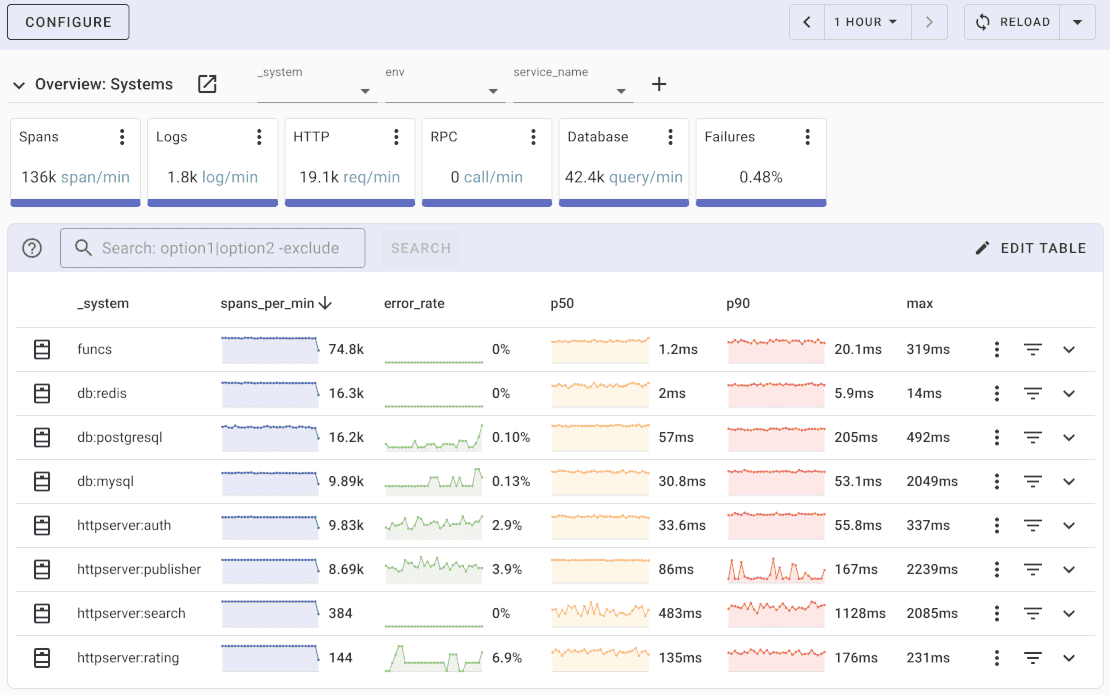
Uptrace comes with an intuitive query builder, rich dashboards, alerting rules with notifications, and integrations for most languages and frameworks. It can process billions of spans and metrics on a single server, allowing you to monitor applications at 10x lower cost.
Creating Kubernetes Dashboards
When telemetry data reaches Uptrace, you can create custom dashboards:
- Navigate to Dashboards tab
- Click New Dashboard
- Add panels to visualize Kubernetes metrics
Useful visualizations include:
- Time series charts for CPU and memory usage over time
- Gauges for current resource utilization
- Tables for listing pods and their current state
- Heatmaps for distribution analysis
Example Queries
Here are useful queries for Kubernetes monitoring, matching the v0.154.0 collector images used in this guide (see CPU metrics naming if you're on an older collector).
CPU usage by namespace:
avg(k8s.pod.cpu.usage) by k8s.namespace.name
Memory usage by pod:
avg(k8s.pod.memory.working_set) by k8s.pod.name, k8s.namespace.name
Container restarts:
sum(k8s.container.restarts) by k8s.pod.name, k8s.namespace.name
Pod phase distribution:
count(k8s.pod.phase) by k8s.pod.phase
Setting Up Alerts
Configure alerts to be notified of potential issues:
- In your dashboard panel, click Set Up Monitors then Create Alerts
- Set conditions, for example:
- Pod restarts > 3 in 10 minutes
- Node memory usage > 85% for 5 minutes
- Deployment available replicas < desired replicas
- Configure notification channels (email, Slack, PagerDuty, etc.)
Getting Started with Uptrace
Try Uptrace by visiting the cloud demo (no login required) or running it locally with Docker. The source code is available on GitHub.
What's next?
Kubernetes cluster monitoring is now operational with OpenTelemetry collectors tracking pods, nodes, and services. For containerized application insights, see Docker instrumentation, or add infrastructure monitoring with PostgreSQL and Redis for complete stack visibility. Explore top APM tools for Kubernetes observability.